

Rethinking The
Connected Kitchen
A community-centered food & kitchen service, built to provide personalized experiences and cultivated by food lovers for food lovers.
TL;DR
Alongside Samsung’s Mobile, Appliance, and Research divisions, the team & I assisted in crafting a unifying Samsung kitchen experience.
We built the foundation for a platform that leverages Samsung’s full breadth of connected products in order to foster community amongst those with a passion for food.
The end result is an ever-evolving platform that relays on user engagement to inspire new experiences and a technology roadmap to bring those experiences to life.
Key Skills
UX Research
Product Strategy
UI Ideation
Prototyping
Tools
Adobe Creative Suite, Figma (prototyping), Principle (recording), Miro, Notion, Sharepoint
Timeline
2 months
Scope
Our User:
Older Millennial cooks of any skill level — those who may choose where to live based on cooking appliance or who are likely to purchase their own kitchen appliances soon.
User Problems: As the need for meaningful food experiences grows, so too does the need for products & services that help create those experiences
User Goals:
Create a community for users to connect and share their love of food using Samsung service & products.
Stakeholder Goals: Drive business growth and create a loyal consumer base by leveraging Samsung’s unique combination of hardware expertise and mobile presence in combination with a food community platform..
Business Challenges: Samsung is evaluating entering the growing global food services market – valued at $3.4T in 2018, and expected to reach $4.2T by 2024.
Project Overview
Star-Crossed Projects
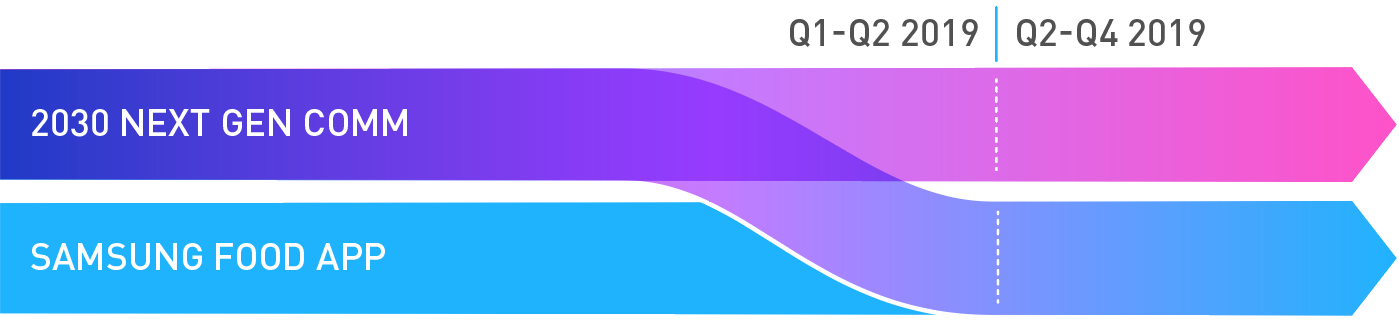
Prior to working on the Food App project, I was a part of the 2030 Next Gen Comm project, a 2030 roadmap for communicative services & devices. Near the 2nd half of 2019, we realized my work heavily coincided with that of the Food App project and I joined the food app to help elevate their findings and build a community-centered platform.
Q1-2: The team first ascertained the human side of the kitchen journey
Review a nationwide survey of >1,000 people
Comb through 22 previous Samsung reports on the subject area
Interview 12 home-chefs of varied skill levels.
Q2-3: Scanning the industry, the team determined what is and isn’t working today
Inspect 55 business models
Evaluate 35 competitors
Highlight relevant technical innovations
Suggest potential acquisitions.
Early Q4: Now understanding user needs + current tech, we started on solutions
Ideate around critical gaps
Develop broad solutions
Test concepts and incorporate feedback from users
Narrow to specific solutions
Devise high-level information architecture
Design wireframes and screens
Build initial prototypes.
Late Q4: Our design team of 4 brought these ideas to life
Envisioning the UX flow.
Assist in wireframing concepts.
Assist in creating a high-level, easily communicated information architecture.
Develop final concept screens
Build out final prototypes
Craft technology strategy

Opportunity Areas + Value Propositions
Development (3 weeks)
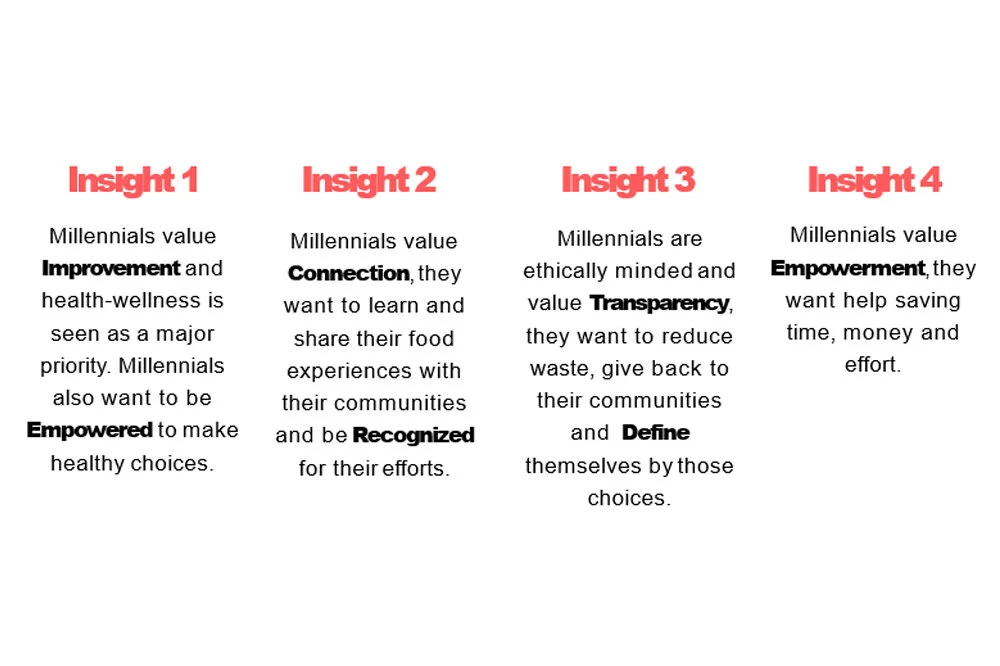
Transformed insights into opportunity areas and value propositions
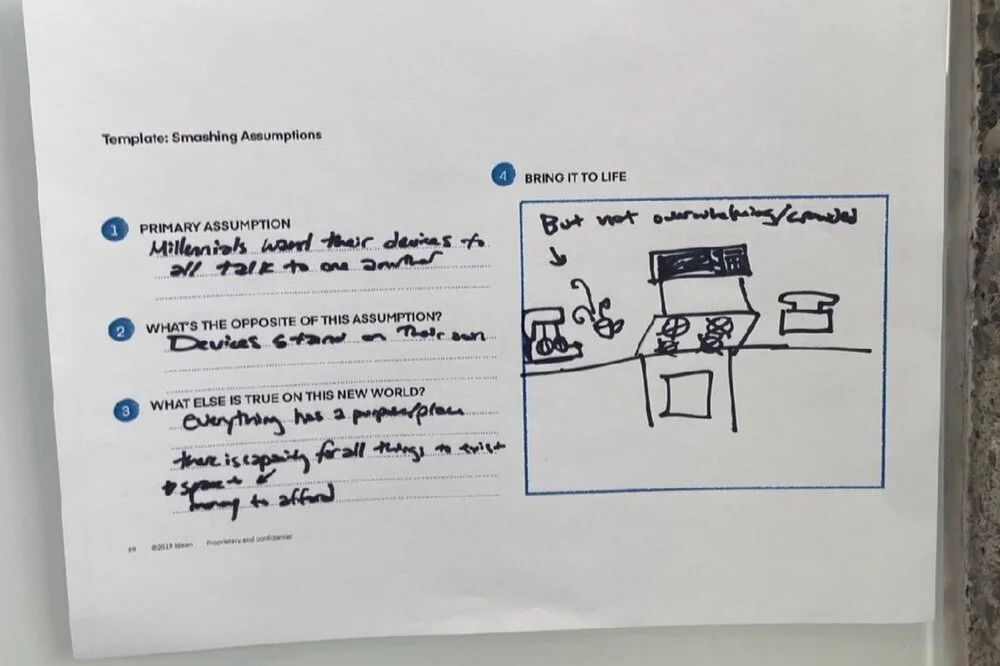
Smashing Assumptions
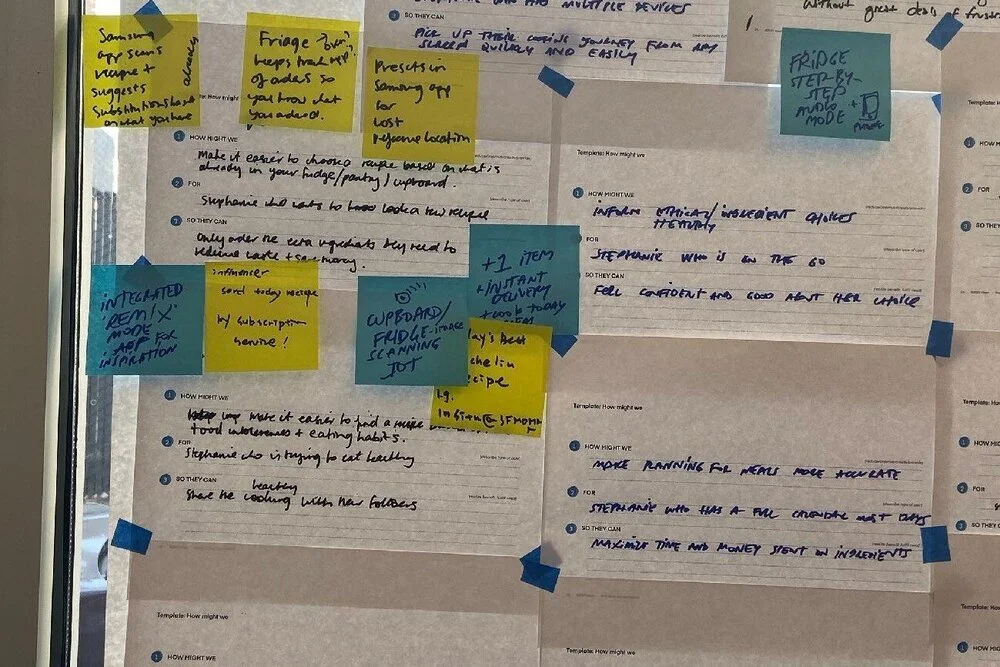
Purposefully disrupted assumptions held around the food + tech space following a simple framework
How Might We
How might we make it easier for people to choose a recipe based on what’s already in the fridge?”
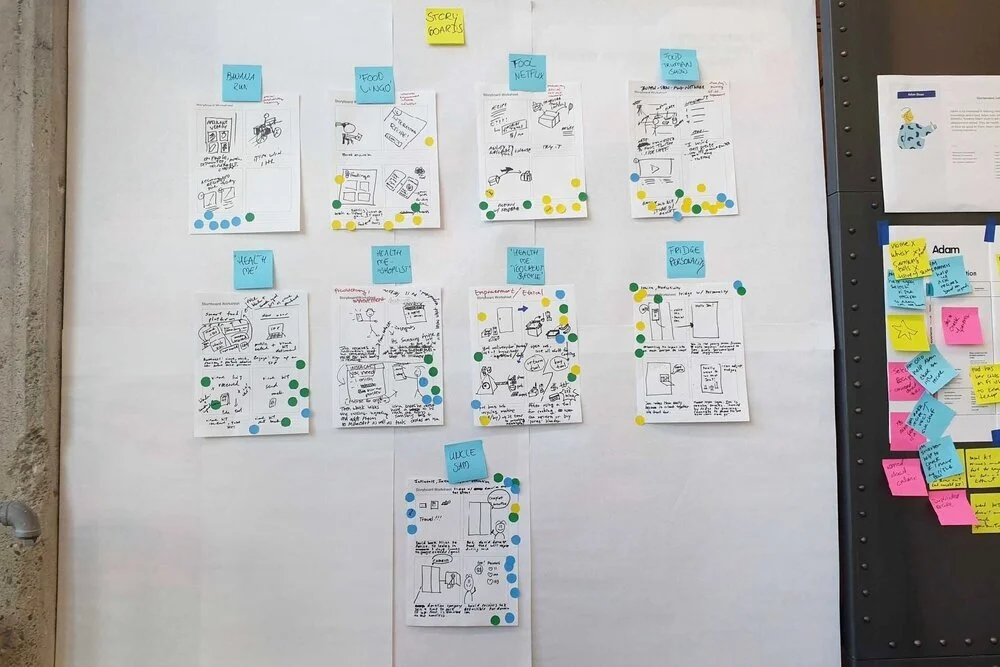
Storyboarding
Developed more flushed out narratives around solutions presented above
User Testing (2 weeks)
The team voted on storyboards to determine which solutions should be explored further and developed into value propositions
Created mock website landing pages (see right for example) to convey and receive feedback on value propositions. Feedback included likes, dislikes, and monthly amount people would be willing to pay for the service
Value Propositions:
Food As Medicine
- auto-customize recipes based on personalized health data (DNA, food sensitivities, health goals)
Chef’s Assistant
- access to/guidance from real chefs in real-time
Good Eats
- food waste prevention through community donation
Remind & Save
- facilitated usage of all food in fridge, focused on saving the users money
Experience Zones (2 weeks)
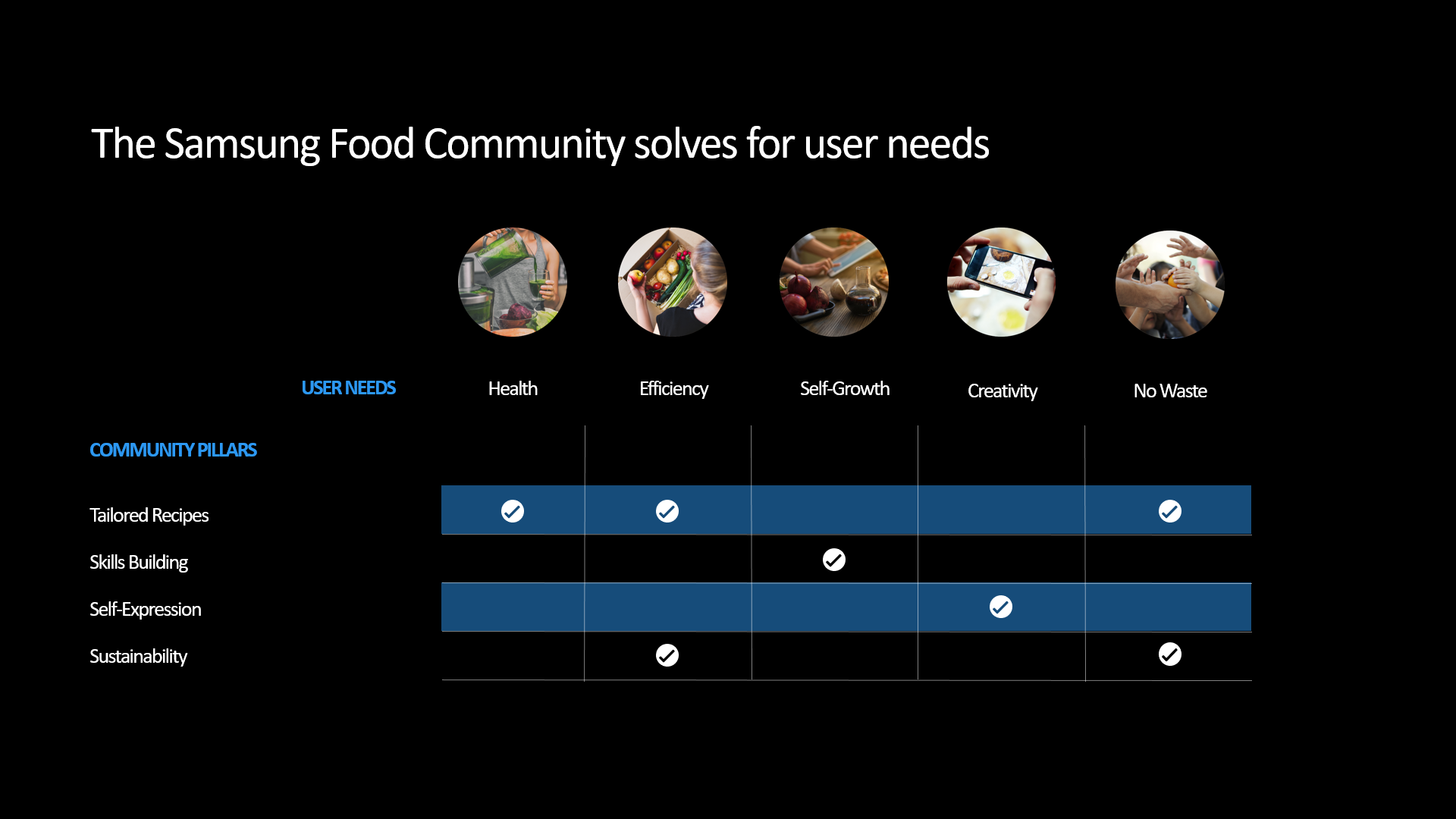
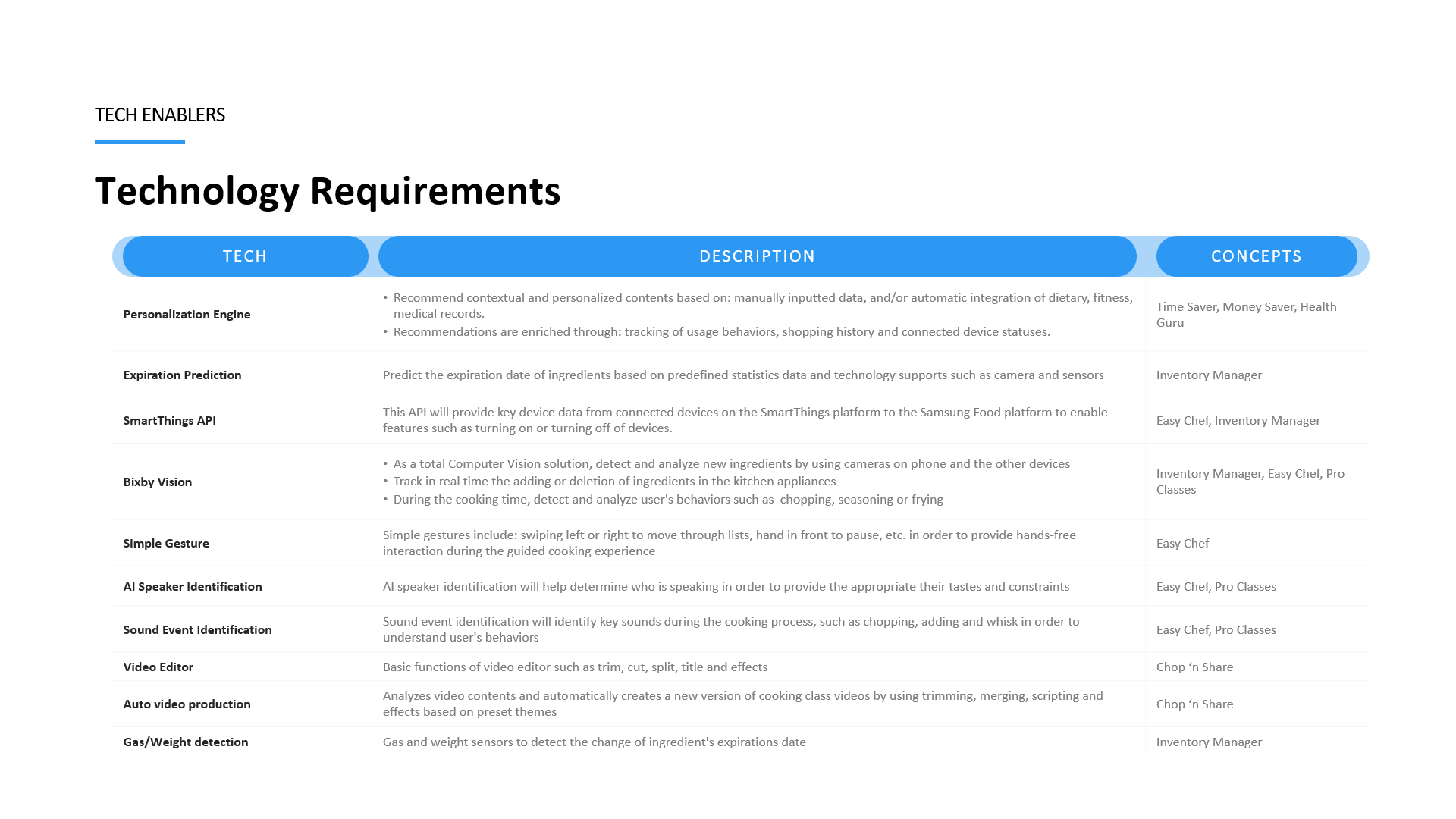
(left) The team was able to align our Value Propositions with User Needs which were cross-referenced with our Community Pillars to better articulate what would become our 7 unique experience zones
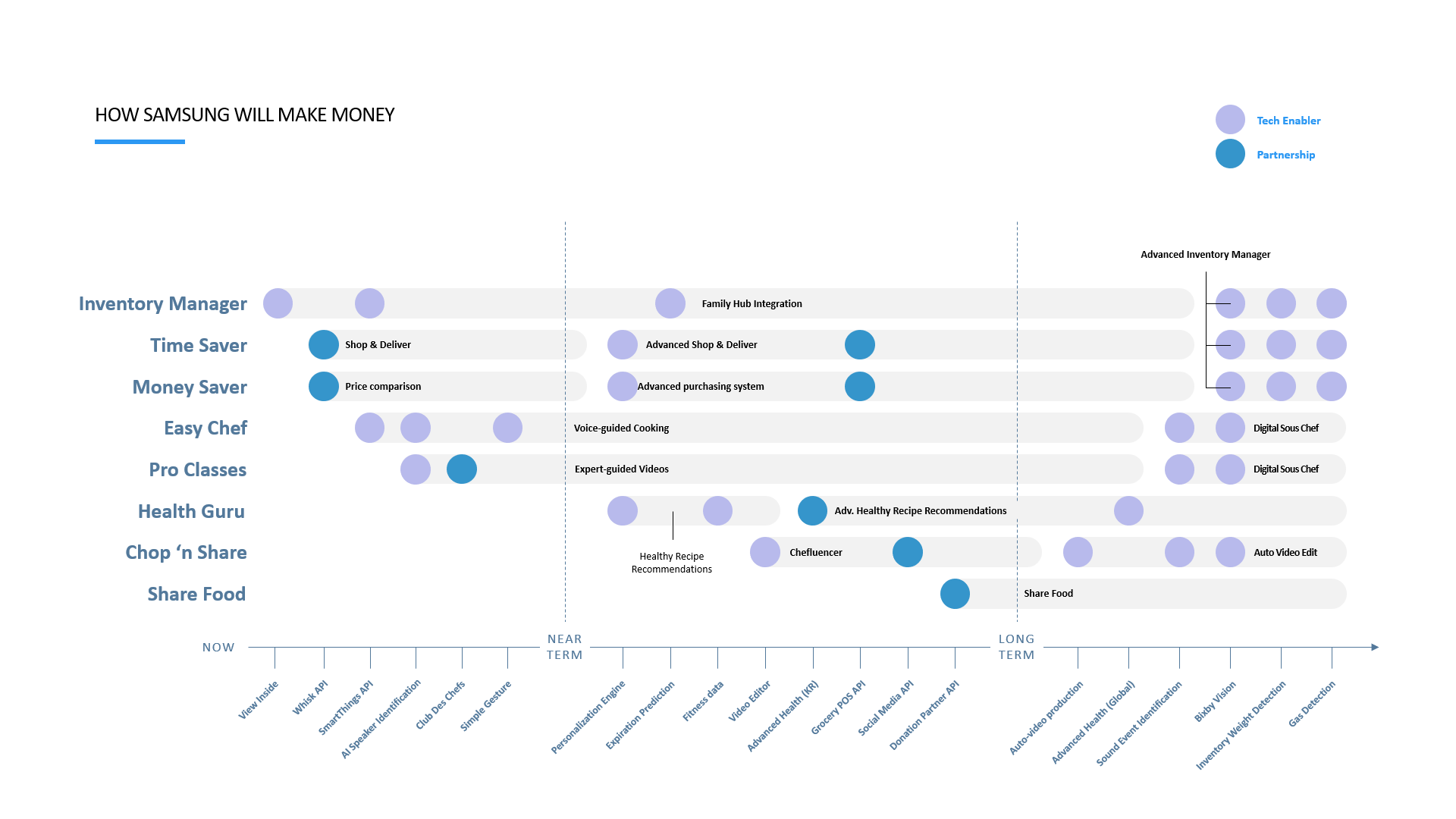
(middle) Those 7 zones encompassed what would become the Food App’s 8 key experiences. In collaboration with software development, we built a roadmap of these experiences based on technology commercialization estimations
(right) These technologies were broken down by type and corresponding key experiences to form a Tech Legend. This legend & roadmap served as a way to better communicate with overseas counterparts as experiences & features were pitched and/or developed

Concept Development
Key Screens + Prototyping (2 weeks)
• Role: assistant designer • Created in Figma
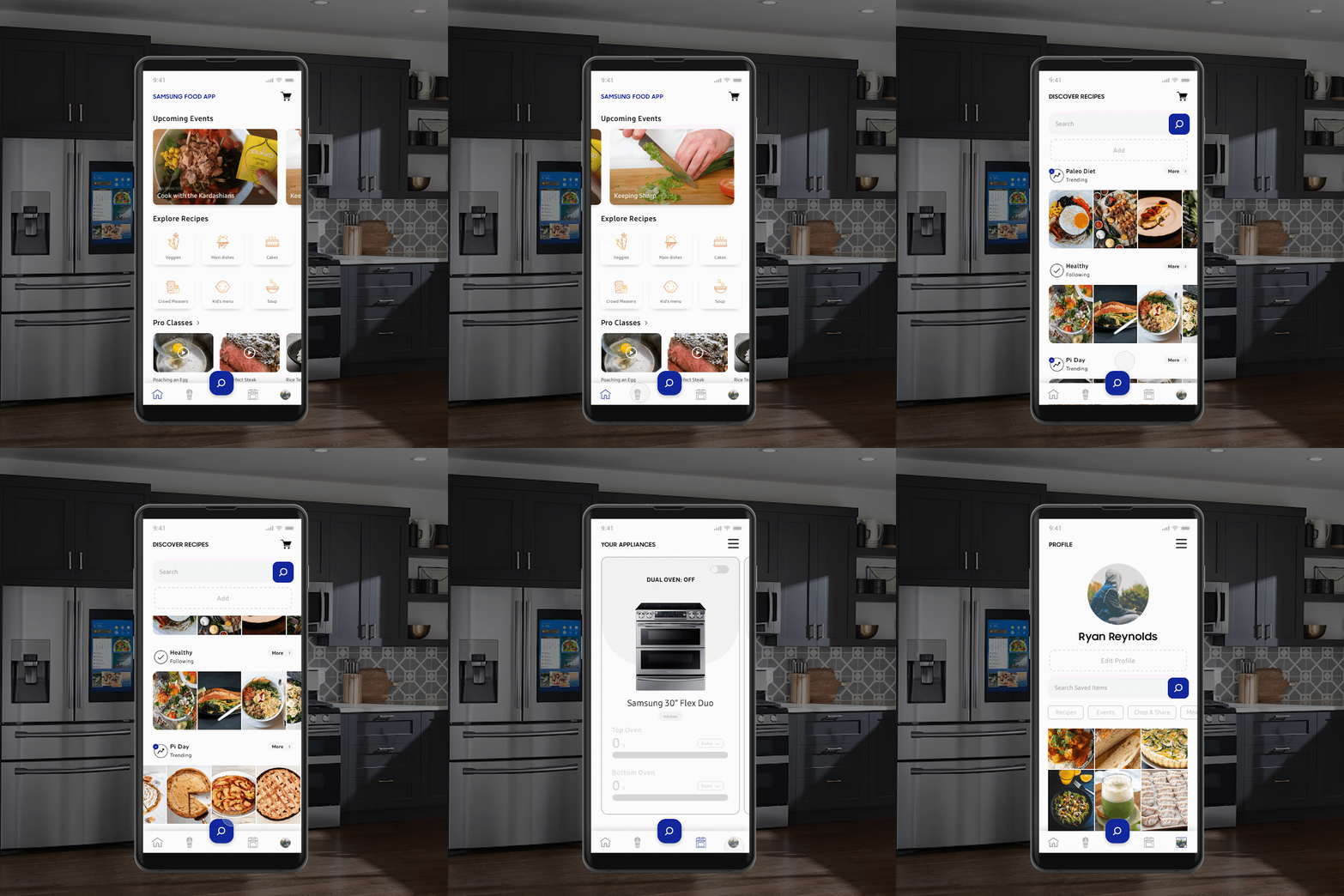
• Designed key screens and flows to convey initial ideas to Samsung stakeholders
• Visualized and added motion to key screens
Note: The presentation deadline was moved up 2 weeks at the last minute, so wireframes were not archived during this phase
Pro Classes (left)
Simplify and personalize the cooking process. On-Demand classes sourced from professional sources such as MasterClass and Club des Chefs
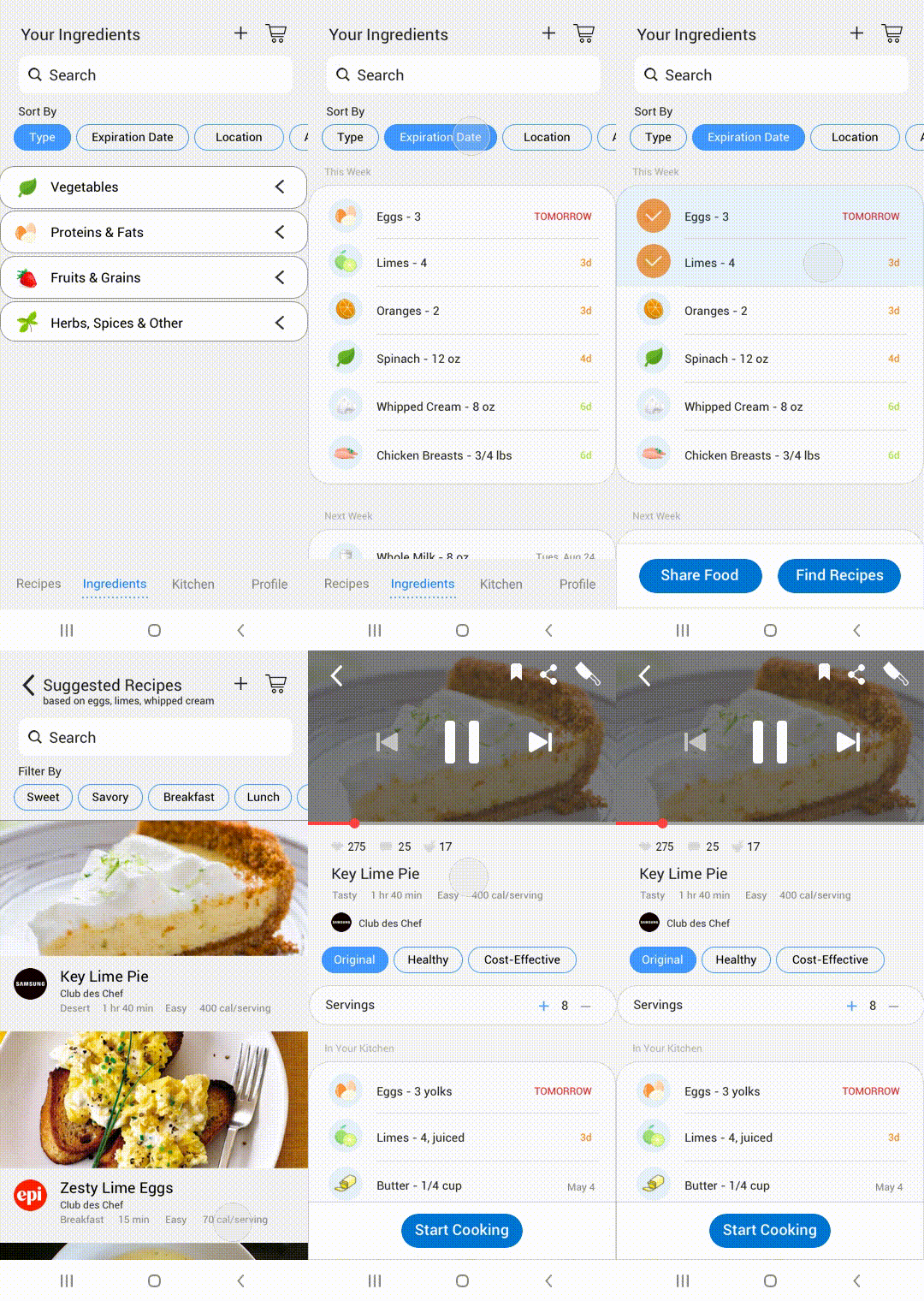
Inventory Manager (right)
Use or give away food items closest to expiring. We plan to determine current food items in a fridge plus approximate expiration dates using emerging smart fridge tech like computer vision, scales, and scent
High-Level Wireframing + IA (1 week)
• Role: assistant designer • Created in Figma
• Laid out key screens and flows to rethink the structure of our concepts
• Addressed stakeholder feedback including:
Feels outdated
Not aligned with One UI 2.0
Confusing how concepts flow together
I addressed this by revisiting, revising, and simplifying the IA (this one) before wireframing
Final Concepts (2 weeks)
• Role: assistant designer • Created in Figma
• Built out a more intricate flow, incorporating the Samsung One UI 2.0 GUI Library
Linking Health
Recommend dietary preferences based on health goals & fitness data from wearables and medical data from gut health & personal genomics services
Health Guru
Target a consumer’s unique dietary needs to assist with life-long wellness improvements through automatic, intelligent and personalized recipes
Inventory Manager
Notifies users when groceries in their refrigerator are about to expire allowing users to prioritize their use of those ingredients
Chop ‘n Share
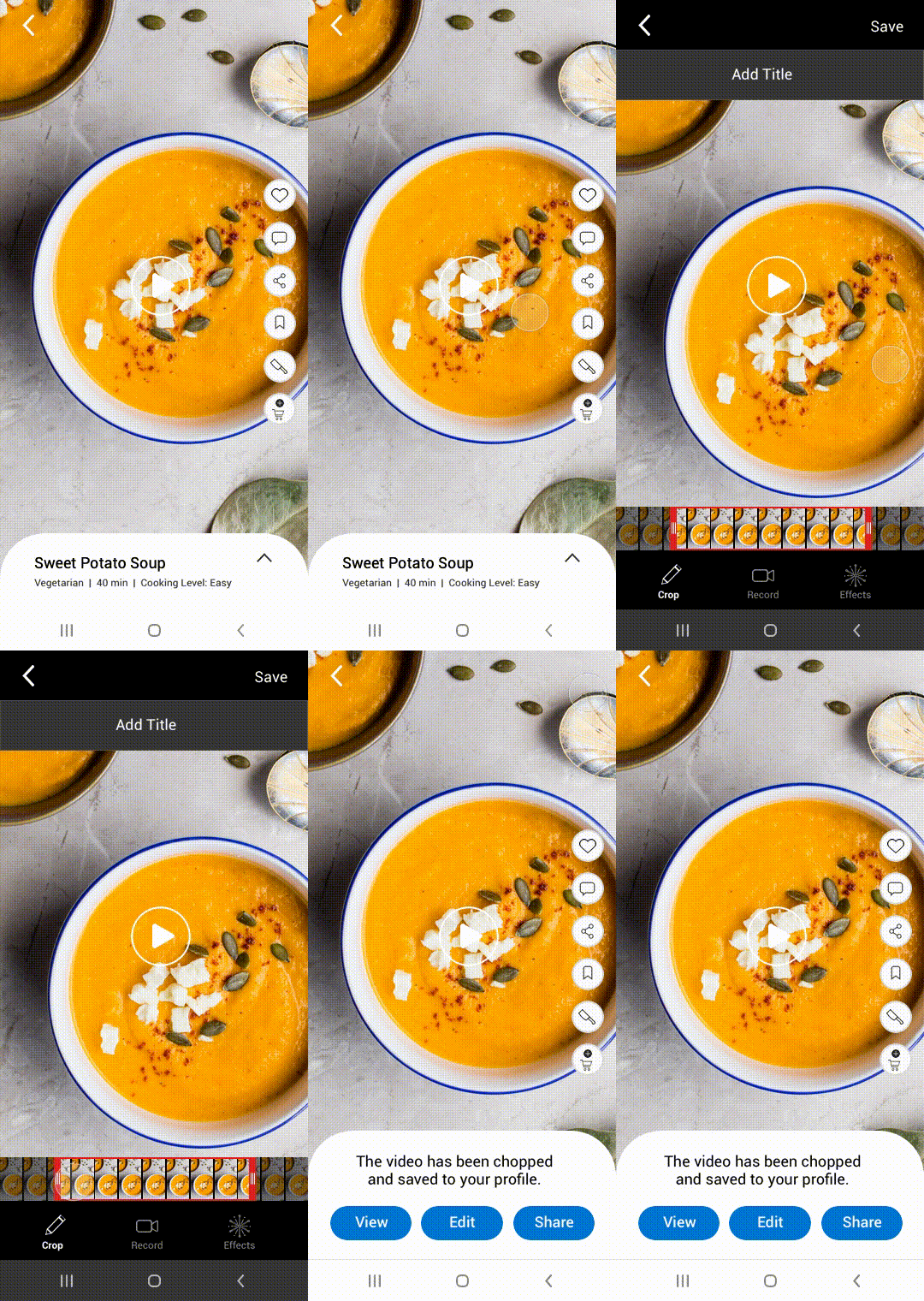
Clip & add parts of existing videos, add personal comments, make adjustments to a recipe and share for other users to try
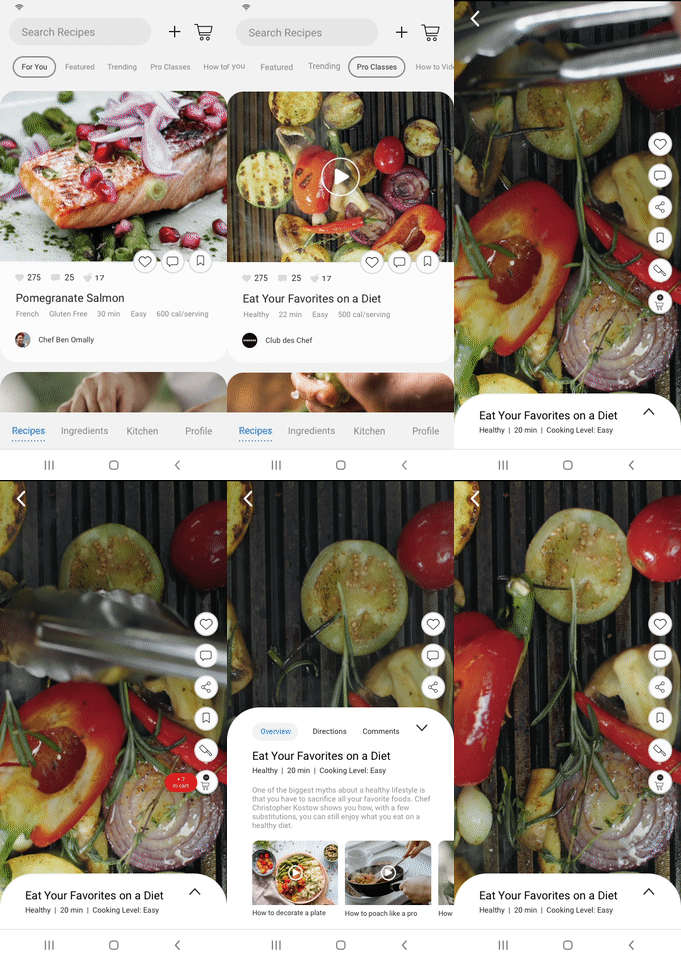
Pro Classes
On-Demand classes sourced from professional sources such as MasterClass and Club des Chefs
Easy Chef
Guided cooking on customizable recipes and smart device integration will help simplify and personalize the cooking process
Money Saver
Recipe recommendations will show multi-grocer price comparisons and commonly consumed foods can be tracked to predict when items are needed & auto-link those purchases with upcoming grocer order
Time Saver
Save time by suggesting recipes & ingredients based on user history, ingredient availability and quick grocery delivery services